
This article has been authored by Kushal Singh Thakur, Intern at Chamber of Manasi Bhushan, Advocates
Introduction
Open courts principle traces its origins back to ancient times, when the retributions for crimes were inflicted upon the criminals openly in front of the community. This law transitioned into the common law system and later became constitutional in several nations worldwide. Open courts concept could be construed as people’s court in which people have free access to the court proceedings. This principle is based on the following notion that the justice should be delivered in front of the public so that there can be no room left for questions about biases and arbitrariness in delivering justice, as when every proceeding is conducted in the presence of litigants, pleaders, and other interested as well as non-interested parties i.e., general public, there will be no or little demur left for unreasonable decisions by the Judges. The concept of open courts enables the ordinary citizens to be aware of the legal developments in the country and empowers them to get knowledge and understanding of the court procedures and justice delivery system. Basically, the purpose of open courts is to promote pure and impartial justice with transparency in proceedings.
India’s stance on Open Courts system
As such our constitution does not explicitly provide any such provision dealing specifically with the open courts, but it can be drawn out from the fundamental rights given in the constitution. Article 19(1)(a) enumerates the right to freedom of speech and expression which encapsulates the right to be heard and participation of the citizens and empower the journalists to publish the faithful report of the proceedings they had witnessed in the Court as observed by the Supreme Court in Naresh Shridhar Mirajkar and Ors. v. State of Maharashtra and Ors., [MANU/SC/0044/1966]. Article 21 is the soul of the constitution which derives the right to have fair hearing and access to justice from the umbrella term of Right to life and personal liberty enshrined therein. Article 145(4) specifically states that “No judgment shall be delivered by the Supreme Court save in open Court, and no report shall be made under article 143 save in accordance with an opinion also delivered in open Court” which meant that supreme court should deliver judgment in open court.
However, ordinary laws both in the civil and criminal sphere entail expressly about the Open courts-
Section 327(1) of Code of Criminal procedure, 1973 states that “The place in which any Criminal Court is held for the purpose of inquiring into or trying any offence shall be deemed to be an open Court, to which the public generally may have access, so far as the same can conveniently contain them”
Also, the Section 153-B of the Code of Civil Procedure, 1908 states that “The place in which any Civil Court is held for the purpose of trying any suit shall be deemed to be an open Court, to which the public generally may have access so far as the same can conveniently contain them”
therefore making it a statutory obligation on the authorities to abide by the foregoing provisions and allow the free access of the public to the trials and inquiries in the courts, as much possible as it is to do.
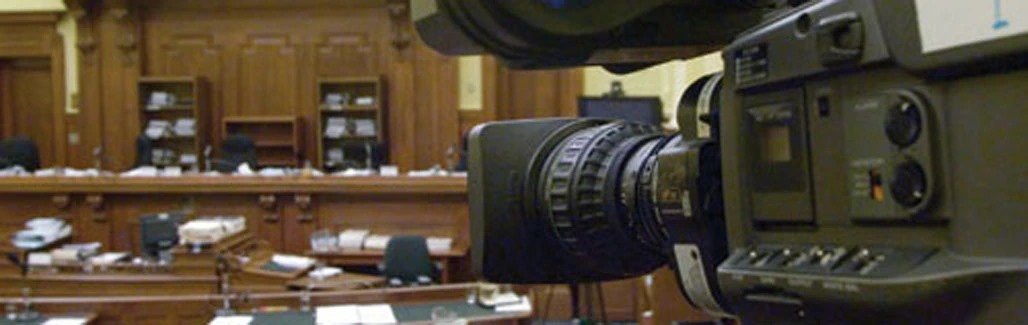
Legal Precedents acknowledging the concept of Open Courts principle
The importance of an open court system has been realized by the Supreme court from time to time in history. In Naresh Shridhar Mirajkar and Ors. vs. State of Maharashtra and Ors. [MANU/SC/0044/1966], Hon’ble Apex Court has while dealing with the matter of publishing the statements of the witnesses by the journalist in the public domain observed that “It is well-settled that in general, all cases brought before the Courts, whether civil, criminal, or others, must be heard in open Court. Public trial in open court is undoubtedly essential for the healthy, objective and fair administration of justice. Trial held subject to the public scrutiny and gaze naturally acts as a check against judicial caprice or vagaries, and serves as a powerful instrument for creating confidence of the public in the fairness, objectivity, and impartiality of the administration of justice. Public confidence in the administration of justice is of such great significance that there can be no two opinions on the broad proposition that in discharging their functions as judicial Tribunals, courts must generally hear causes in open and must permit the public admission to the courtroom”.
Court also opined that this right of open hearing is not inviolable but if necessary should be regulated or controlled in the interest of administration of justice.
Further, House of lords in Scott vs Scott [1913] AC 417, while dealing with the matter of divorce petition filed by wife on the ground of impotency of husband, quoted the legal theory of renowned philosopher and jurist Jeremy Bentham, as it says “In the darkness of secrecy sinister interest, and evil in every shape, have full swing. Only in proportion as publicity has taken place can any of the checks applicable to judicial injustice operate. Where there is no publicity there is no justice. Publicity is the very soul of justice.”.
These wittiest words brought our attention towards the value of publicity of court proceedings which not only fulfill the purpose of delivering justice in the matter concerning social issues but also for serving better to the community.
In Mohd. Shahabuddin v. State of Bihar, [MANU/SC/0203/2010] upheld the concept of open courts and opined that “In my considered view an “open court” is a court to which general public has a right to be admitted and access to the court is granted to all the persons desirous of entering the court to observe the conduct of the judicial proceedings”.
In the case of Swapnil Tripathi and Ors. vs. Supreme Court of India and Ors. [MANU/SC/1066/2018], a writ petition was filed by a law student along with others for declaration that the supreme court proceedings of constitutional importance having impact on the larger public interest should be made live streamed so that it is easily accessible to the public viewing it. Court framed the guidelines and directions for live streaming of court proceedings of the supreme court and also upheld the principle of open court in the administration of justice.
Circumstances when the reasonable restrictions can be exercised in acknowledging the Open Courts Principle.
In certain circumstances, the open court principle may be compromised based on the discretion of the presiding judge as given in the appropriate statutory provisions. Following are the possible scenarios in which the public can be prohibited to attend the proceedings in the open court and the proceeding be recorded on camera for the ensuring the dignity of the victim and privacy of the victim and witnesses as well as accused.
Analyzing the significance of Open Courts system in the effective administration of justice
Unless justice is seen to be done it probably seems to not be done. Following the open court system in an adversarial system of delivering justice is highly appreciable but also commendable if it has been observed positively by the democratic nations like India. This not only builds confidence among citizens but also allows them to participate in assisting the state machinery in pursuit of administration of justice. Following are the various effects of having an Open court system in state-
Conclusion
In conclusion, the principle of open courts remains integral to the democratic fabric of nations, ensuring accountability, transparency, and public trust in the legal system. While recognizing the need for occasional restrictions, it is imperative to uphold and reinforce this principle to uphold the ideals of justice and the rule of law.
